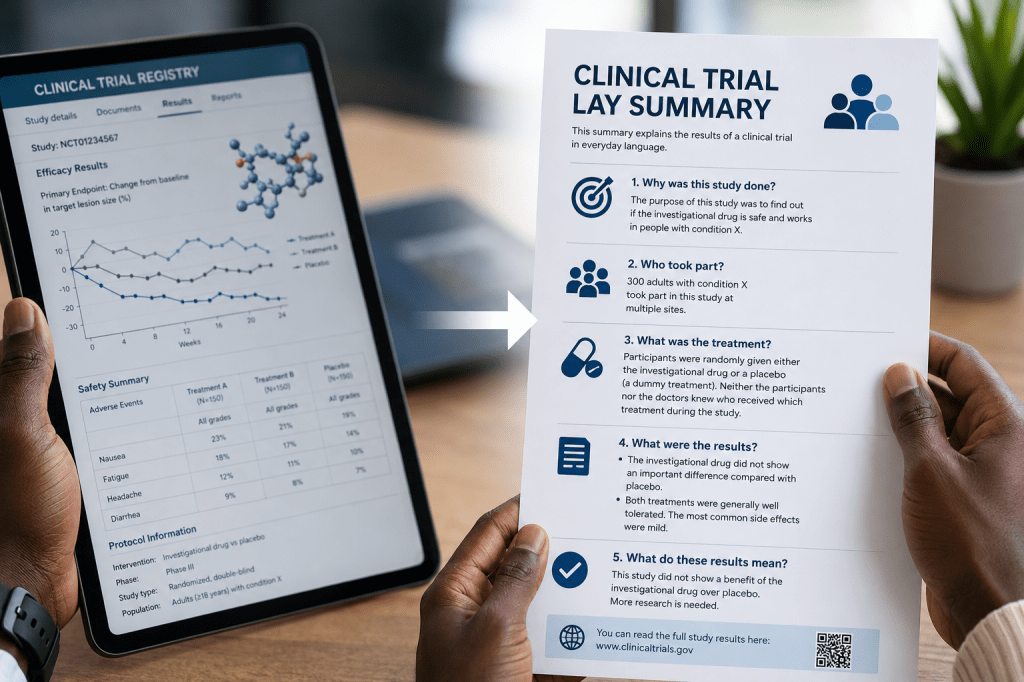
An educational narrative review from a medical writing perspective
By Femi Fajimi | 18 May 2026
Abstract
Clinical trial lay summaries have emerged as important tools for improving transparency and public understanding of clinical research following increasing regulatory emphasis on patient-focused communication. Regulatory frameworks such as the European Union Clinical Trials Regulation (EU CTR) No. 536/2014 require sponsors to provide publicly accessible summaries of clinical trial results written in language understandable to non-specialist audiences. However, questions remain regarding whether lay summaries are genuinely accessible, understandable, and useful to patients and the wider public.
This article explores the role, accessibility, and practical usefulness of clinical trial lay summaries from a medical writing perspective. Key issues discussed include public access through platforms such as the Clinical Trials Information System (CTIS), readability and health literacy challenges, the impact of overly technical language, and the distinction between regulatory compliance and meaningful communication. The article also examines the central role of medical writers in translating complex scientific information into clear, balanced, and patient-friendly language while maintaining scientific accuracy and non-promotional standards.
Although lay summaries have strengthened transparency initiatives in clinical research, their effectiveness ultimately depends on the quality of the writing, accessibility, and the audience’s understanding. Meaningful transparency requires not only public availability of information, but also the ability of patients and non-specialist readers to locate, understand, and engage with clinical trial results effectively.
1. Introduction
Clinical trial transparency has become an increasingly important component of modern healthcare research, as patients, regulators, and the wider public demand greater access to understandable clinical research information (World Health Organisation [WHO], 2015). Historically, clinical trial findings were primarily communicated through scientific journal publications, regulatory reports, and technical documents intended for healthcare professionals, regulators, and researchers (European Union, 2014). Although these documents provide detailed scientific information, they are often difficult for non-specialists to understand because they contain technical terminology, statistical language, and complex clinical concepts (O’Reilly et al., 2023).
To address this communication gap, regulatory authorities and healthcare stakeholders have increasingly promoted the use of clinical trial lay summaries, also referred to as plain language summaries (Good Lay Summary Practice [GLSP], 2021). Lay summaries are simplified, non-technical overviews intended to explain the purpose, methods, results, and significance of clinical trials in language understandable to patients, caregivers, trial participants, and members of the public without scientific training (GLSP, 2021). Their development reflects a broader shift toward patient-centred communication and greater public involvement in healthcare decision-making (EUPATI, 2018).
The importance of lay summaries increased significantly following the implementation of the European Union Clinical Trials Regulation (EU CTR) No. 536/2014, which requires sponsors to provide publicly accessible lay summaries of clinical trial results (European Union, 2014). These summaries are published through the Clinical Trials Information System (CTIS), which was developed to improve transparency and public access to clinical trial information across the European Union (European Medicines Agency [EMA], 2022). Similarly, the WHO has emphasised the ethical importance of publicly disclosing clinical trial results in accessible formats to improve transparency and accountability in clinical research (WHO, 2015).
Despite increasing regulatory emphasis, concerns remain regarding the practical accessibility and usefulness of lay summaries. Research suggests that awareness of lay summaries among the public remains variable, while readability, discoverability, and health literacy continue to influence how effectively these summaries are understood (Getz & Campo, 2017). South et al. (2025) also reported that trial participants highly value receiving understandable information about study outcomes, highlighting the importance of communicating results in formats that are meaningful to non-specialist audiences.
These challenges place medical writers at the centre of effective clinical trial communication. Medical writers are responsible for translating highly technical scientific and clinical information into clear, balanced, and understandable language suitable for diverse audiences (TransCelerate BioPharma, 2020).
This process requires not only scientific accuracy but also an understanding of readability principles, audience expectations, health literacy considerations, and regulatory requirements (GLSP, 2021). This article explores public access to clinical trial lay summaries, examines their usefulness and accessibility, and discusses the role of medical writers in improving the clarity, relevance, and effectiveness of patient-focused clinical research communication.
2. What Are Clinical Trial Lay Summaries?
Clinical trial lay summaries, also referred to as plain language summaries, are simplified overviews of clinical trial information written specifically for individuals without scientific or medical training (Good Lay Summary Practice [GLSP], 2021). They are intended to communicate clinical research findings in language that patients, caregivers, trial participants, and members of the public can understand more easily than conventional scientific or regulatory documents (Expert Group on Clinical Trials, 2018).
The primary purpose of lay summaries is to improve transparency and public understanding of clinical research outcomes (World Health Organisation [WHO], 2015). They are designed to explain key aspects of a clinical trial, including the study’s purpose, the treatment investigated, how the trial was conducted, the main findings, potential risks and benefits, and the overall conclusions of the research (Expert Group on Clinical Trials, 2018). By presenting this information in accessible language, lay summaries aim to support informed public engagement and help participants better understand the outcomes of studies in which they were involved (South et al., 2025).
The intended audience for lay summaries includes trial participants, patients, caregivers, patient advocacy groups, and members of the general public who may not possess scientific or medical expertise (GLSP, 2021). This target cohort differs significantly from the audience of scientific journal publications and regulatory reports, which are primarily written for clinicians, regulators, researchers, and other scientific professionals (O’Reilly et al., 2023). Scientific summaries frequently contain complex terminology, statistical analyses, and technical methodological descriptions that may be difficult for non-specialist audiences to interpret accurately (O’Reilly et al., 2023); consequently, lay summaries differ from scientific summaries not only in language but also in structure, tone, and presentation. Plain language principles encourage writers to avoid unnecessary jargon, explain medical terminology clearly, use shorter sentences, organise information logically, and prioritise readability for non-expert readers (National Institutes of Health [NIH], 2025). The Good Lay Summary Practice guidance further emphasises the importance of clarity, cultural appropriateness, patient involvement, and accessibility as essential components of effective lay summary development (GLSP, 2021).
The regulatory importance of lay summaries increased substantially following the implementation of the European Union Clinical Trials Regulation (EU CTR) No. 536/2014 (European Union, 2014). Under this regulation, sponsors conducting clinical trials within the European Union are required to provide publicly accessible summaries of clinical trial results written specifically for laypersons (European Union, 2014). This requirement was introduced to improve transparency, public trust, and access to understandable clinical research information (European Union, 2014).
To support this transparency initiative, the European Medicines Agency (EMA) developed the Clinical Trials Information System (CTIS), a centralised online platform used for the submission and publication of clinical trial information within the European Union (European Medicines Agency [EMA], 2022). CTIS enables members of the public to access information about ongoing and completed clinical trials, including lay summaries of study results (EMA, 2022). The platform represents a significant step toward improving public visibility of clinical research and facilitating broader access to understandable trial outcomes (EMA, 2022).
In response to evolving regulatory expectations, several organisations and industry groups have also produced guidance documents to support the preparation of effective lay summaries. One of the most influential frameworks is the Good Lay Summary Practice (GLSP) guidance, developed collaboratively by regulators, patient organisations, industry representatives, and medical communication professionals (GLSP, 2021). The guidance provides practical recommendations regarding readability, structure, audience consideration, and patient-focused communication principles (GLSP, 2021).
Although the requirement for lay summaries has strengthened transparency efforts in clinical research, the quality and accessibility of these summaries can still vary considerably depending on writing style, terminology, structure, and audience consideration (O’Reilly et al., 2023). As a result, medical writers play a central role in ensuring that lay summaries are not only regulatory-compliant but also genuinely understandable and useful to the public.
3. Why Lay Summaries Matter
Lay summaries have become increasingly important because they support greater transparency in clinical research and provide patients and the public with understandable information about clinical trial outcomes (World Health Organisation [WHO], 2015). Historically, many clinical trial participants did not routinely receive clear feedback regarding the results of studies in which they participated, despite contributing their time, personal information, and, in some cases, accepting significant risks during the research process (South et al., 2025).
Providing understandable trial results is increasingly viewed as an ethical responsibility within clinical research communication (EUPATI, 2018). The World Health Organisation (2015) emphasised that public disclosure of clinical trial results promotes accountability, transparency, and respect for research participants. Similarly, EUPATI (2018) highlighted that participants have a legitimate interest in knowing the outcomes of studies to which they contributed, particularly when the research may influence future healthcare decisions and treatment development.
Returning study results to participants may also strengthen participant engagement and satisfaction with the research process (South et al., 2025). In reviews examining practices surrounding result communication, South et al. (2025) reported that many participants highly valued receiving trial outcomes in understandable formats, proving that accessible communication directly improves participants’ perceptions of transparency and respect within clinical research.
Lay summaries may also help improve public trust in clinical research and the pharmaceutical industry; Getz and Campo (2017) found that participants increasingly expect transparency regarding clinical trial information and results disclosure. Limited communication or inaccessible reporting may contribute to mistrust, misunderstanding, or perceptions that research findings are being withheld from the public (Getz & Campo, 2017). By contrast, accessible and transparent communication may help improve confidence in clinical research processes and strengthen public engagement with healthcare innovation (Getz & Campo, 2017).
Health literacy also plays an important role in determining whether lay summaries are genuinely useful to patients and the public; Berkman et al. (2011) noted that many individuals experience difficulty understanding technical health information because of literacy and comprehension challenges. As a result, scientifically accurate information may still fail to communicate effectively if presented in overly technical terminology or complex sentence structures (O’Reilly et al., 2023). Lay summaries, therefore, aim to reduce communication barriers by presenting clinical information in more accessible language and formats (Good Lay Summary Practice [GLSP], 2021).
The growing emphasis on lay summaries also reflects broader shifts toward patient-centred communication in healthcare and research (EUPATI, 2018). Patient-centred communication prioritises patients’ informational needs, preferences, and understanding rather than focusing solely on scientific or regulatory audiences (EUPATI, 2018). In this context, lay summaries go beyond regulatory obligations; they serve as tools to support informed public engagement and improve the accessibility of clinical research information (WHO, 2015; EUPATI, 2018).
For medical writers, this increasing emphasis on transparency and patient-centred communication has expanded the importance of writing skills that extend beyond technical scientific documentation. Writers are now expected not only to communicate accurate scientific information, but also to ensure that information is understandable, meaningful, and accessible to non-specialist audiences.
4. Public Access: Where Are Lay Summaries Found?
Public access to clinical trial lay summaries has increased following regulatory transparency initiatives introduced within the European Union (European Union, 2014). One of the main platforms through which lay summaries are publicly available is the Clinical Trials Information System (CTIS), developed by the European Medicines Agency (EMA) under the European Union Clinical Trials Regulation (EU CTR) No. 536/2014 (European Medicines Agency [EMA], 2022). CTIS functions as a centralised online portal that provides public access to clinical trials conducted within the European Union, including trial protocols, study status information, and lay summaries of completed trials.
In addition to CTIS, some trial sponsors voluntarily publish lay summaries through their own corporate transparency websites or patient-facing portals as part of broader clinical trial disclosure initiatives (EFPIA & PhRMA, 2014). However, these company-specific disclosures depend entirely on individual sponsor practices and lack the standardised publishing mandates enforced by the EU Clinical Trials Regulation (EFPIA & PhRMA, 2014; European Union, 2014; EMA, 2022).
Clinical trial databases such as CTIS contain large volumes of regulatory and technical information intended to support transparency and trial oversight (EMA, 2022). As a result, individuals unfamiliar with clinical trial terminology, sponsor information, or study identifiers may have difficulty locating specific studies or lay summaries (European Patients’ Forum [EPF], 2016; McCray et al., 2007).
The existence of publicly available summaries does not necessarily guarantee meaningful public access if intended users cannot easily identify, navigate, or understand the information provided (EPF, 2016). Transparency, therefore, extends beyond publication alone and includes practical considerations such as visibility, discoverability, usability, and audience-centred communication (Weerakkody et al., 2017).
For medical writers, these limitations highlight that effective public communication involves more than simplifying scientific language. Accessibility also depends on how information is organised, presented, and made discoverable for non-specialist audiences.
5. Are Lay Summaries Actually Useful to the Public?
Although lay summaries were introduced to improve transparency and public understanding of clinical research, their usefulness depends largely on whether non-specialist audiences can meaningfully read, interpret, and apply the information they provide (Klingmann, 2023; Raynor et al., 2018). Public availability alone does not necessarily guarantee comprehension, particularly when summaries remain complex, highly technical, or poorly adapted to lay readers’ needs (Good Lay Summary Practice [GLSP], 2021).
One of the most significant challenges affecting the usefulness of lay summaries is variable readability; readability refers to how easily written information can be understood by its intended audience (Berkman et al., 2011). Studies examining patient-facing health information have consistently shown that many health-related documents are written at a level above the average public reading level, limiting comprehension among individuals with lower health literacy (Berkman et al., 2011; Rudd, 2015). Empirical evaluations indicate that this issue significantly affects clinical trial lay summaries, in which complex sentence structures, scientific terminology, or unexplained statistical concepts are routinely retained despite explicit mandates to simplify the content (O’Reilly et al., 2023).
Health literacy barriers further determine whether members of the public can truly benefit from lay summaries; it involves an individual’s ability to obtain, process, and understand basic health information needed to make informed decisions (Institute of Medicine [IOM], 2004). Individuals with limited health literacy may experience difficulty interpreting medical terminology, understanding trial outcomes, or recognising the clinical significance of research findings (McCray et al., 2007). Consequently, even summaries written with transparency intentions may fail to communicate effectively if readability and audience comprehension are not adequately considered (O’Reilly et al., 2023).
Overly technical language remains another important limitation; lay summaries are intended to simplify scientific information, yet some summaries continue to include terminology unfamiliar to non-specialist audiences, including statistical terms, clinical endpoints, or regulatory language (GLSP, 2021). While scientific accuracy must be maintained, excessive technicality may reduce accessibility and discourage engagement among readers without scientific backgrounds (Good Lay Summary Practice [GLSP], 2021; O’Reilly et al., 2023; Stricker et al., 2021).
These challenges raise important questions regarding the distinction between regulatory compliance and functional accessibility. A lay summary may technically satisfy regulatory requirements by being publicly available and written in simplified language, while still failing to support genuine public understanding (Expert Group on Clinical Trials, 2018). In practice, accessibility involves more than publication alone; it also requires that information is understandable, relevant, and usable for intended audiences (Berkman et al., 2011; Good Lay Summary Practice [GLSP], 2021; Raynor et al., 2018; Weerakkody et al., 2017).
Another important consideration is whether readers truly understand the information presented within lay summaries. Understanding involves more than recognising simplified words or shorter sentences; therefore, readers must also be able to interpret the significance of study findings, understand potential risks and benefits, and appreciate the broader implications of trial outcomes (IOM, 2004). Without this deeper level of comprehension, transparency efforts may have limited practical impact on patient engagement or public understanding (O’Reilly et al., 2023).
From a medical writing perspective, these issues highlight that effective lay summary development requires more than reducing scientific complexity. Writers must consider readability, audience expectations, contextual explanation, information structure, and health literacy principles simultaneously, balancing scientific accuracy with meaningful accessibility for non-specialist readers.
Importantly, the usefulness of lay summaries should not be evaluated solely by regulatory fulfilment or publication metrics. Their true value may depend on whether patients and the public can genuinely engage with, understand, and benefit from the information communicated.
6. The Role of Medical Writers
Medical writers play a central role in developing clinical trial lay summaries, translating complex scientific and clinical information into language understandable to non-specialist audiences (Good Lay Summary Practice [GLSP], 2021). Unlike traditional regulatory or scientific documents written primarily for healthcare professionals and regulators, lay summaries must communicate research findings in ways that are accessible to patients, caregivers, and members of the public without compromising scientific accuracy (Expert Group on Clinical Trials, 2018).
One of the primary responsibilities of medical writers in lay summary development is translating scientific concepts into understandable language ge (Good Lay Summary Practice [GLSP], 2021). Clinical trial information often contains technical terminology, statistical analyses, pharmacological concepts, and regulatory language that may be unfamiliar to non-scientific audiences (O’Reilly et al., 2023). Medical writers must therefore interpret and simplify this information while ensuring the data’s meaning remains accurate and balanced (GLSP, 2021).
Balancing simplicity with scientific accuracy is one of the most challenging aspects of lay summary writing; excessive simplification may remove important clinical context or lead to misleading interpretations, whereas overly technical explanations may reduce comprehension and accessibility (Expert Group on Clinical Trials, 2018). Medical writers must therefore make careful decisions regarding terminology selection, risk and benefit explanations, and the presentation of study findings to ensure that summaries remain both understandable and scientifically reliable.
Tone and structure are also important components of effective lay summary communication; plain language guidance recommends shorter sentences, logical organisation, active voice where appropriate, and reader-friendly formatting to improve comprehension (National Institutes of Health [NIH], 2025). Clear headings, simplified explanations, and structured information flow may help readers navigate complex clinical information more effectively (GLSP, 2021).
Medical writers must also avoid promotional or biased language when preparing lay summaries; therefore, clinical trial communications are expected to remain objective, balanced, and non-promotional, particularly when discussing treatment benefits or study outcomes (EFPIA & PhRMA, 2014). Overstating positive findings, minimising risks, or using emotionally persuasive wording may compromise the credibility and ethical integrity of the summary.
Cultural and literacy considerations further influence the effectiveness of patient-facing communication; health literacy levels vary considerably across populations, and cultural differences may affect how medical information is interpreted and understood (Institute of Medicine [IOM], 2004). Medical writers, therefore, need to consider readability, language clarity, and audience diversity when developing lay summaries intended for broad public audiences (McCray et al., 2007).
The increasing emphasis on patient-focused communication has also expanded the role of medical writers beyond traditional technical writing functions, prioritising patients’ informational needs and understanding rather than focusing solely on scientific completeness (EUPATI, 2018). Consequently, medical writers are increasingly expected to apply communication strategies that improve accessibility, engagement, and practical understanding for non-specialist readers.
In this context, effective lay summary writing requires more than scientific knowledge alone. It also requires communication skills, audience awareness, ethical responsibility, and an understanding of how patients and the public engage with health information. The quality of lay summaries may therefore depend not only on the underlying clinical data but also on the ability of medical writers to communicate those findings clearly, accurately, and meaningfully.
7. Characteristics of Effective Lay Summaries
The effectiveness of a clinical trial lay summary depends not only on the accuracy of the scientific information presented, but also on how clearly and meaningfully the information is communicated to non-specialist audiences (Good Lay Summary Practice [GLSP], 2021). Effective lay summaries should therefore be designed with readability, accessibility, and audience understanding as central priorities rather than focusing solely on regulatory compliance.
One of the most important characteristics of an effective lay summary is the use of plain language; plain language presents information clearly and straightforwardly, allowing readers to understand the message without specialised scientific knowledge (National Institutes of Health [NIH], 2025). This includes avoiding unnecessary technical terminology, explaining medical concepts in simple language, and choosing familiar words where possible (GLSP, 2021).
Short sentences and concise writing may also improve readability and comprehension, particularly for readers with limited health literacy (Institute of Medicine [IOM], 2004). Long or highly complex sentences may increase cognitive burden and reduce understanding among non-specialist audiences (Stricker et al., 2021). Consequently, effective lay summaries often use shorter sentences and simpler explanations to improve accessibility.
Logical organisation and clear headings are equally important for improving navigation and reader engagement; structured sections such as “Why was this study done?”, “What were the results?” and “What do the findings mean?” may help readers follow clinical information more easily (Expert Group on Clinical Trials, 2018). Clear headings also improve information retrieval by enabling readers to identify relevant sections quickly.
Contextual explanations may further improve understanding by helping readers interpret unfamiliar clinical concepts or study findings; for example, explaining why a clinical endpoint matters or describing the practical significance of treatment outcomes may make trial results more meaningful to patients and caregivers (GLSP, 2021). Without context, readers may recognise simplified words while still struggling to understand the information presented.
Minimising jargon remains another key feature of effective lay summaries. Medical and regulatory terminology may create communication barriers for individuals without scientific backgrounds (O’Reilly et al., 2023). Where technical terms are necessary, they should be clearly explained in simple language, with practical examples where appropriate (NIH, 2025).
The use of visuals may also improve accessibility and reader comprehension. Diagrams, icons, infographics, and simple charts may help communicate complex information more effectively than text alone, particularly when explaining study design, treatment groups, or key outcomes (Expert Group on Clinical Trials, 2018). Visual elements may additionally improve engagement and reduce information overload for readers unfamiliar with scientific documents.
Patient-friendly framing is another important consideration in lay summary writing. Patient-focused communication prioritises relevance, empathy, and clarity from the reader’s perspective rather than simply presenting scientific findings in simplified language (EUPATI, 2018). Effective lay summaries, therefore, consider what information patients are most likely to find meaningful, including treatment impact, safety outcomes, and practical implications of the study findings.
Importantly, effective lay summaries should not oversimplify or distort scientific findings in an attempt to improve readability. Medical writers must maintain a balance between accessibility and scientific accuracy to ensure that information remains trustworthy, objective, and ethically appropriate (GLSP, 2021).
Ultimately, the quality of a lay summary depends on whether readers can genuinely understand and engage with the information presented. Effective communication, therefore, involves not only simplifying language but also designing information in ways that support comprehension, relevance, and meaningful public understanding.
8. Current Challenges and Future Directions
Despite increasing regulatory support for clinical trial lay summaries, several challenges continue to affect their consistency, accessibility, and long-term effectiveness. As transparency requirements evolve globally, concerns remain regarding standardisation, readability, translation quality, technological influence, and the ability to evaluate whether lay summaries genuinely improve public understanding (Good Lay Summary Practice [GLSP], 2021).
One major challenge is the lack of global standardisation in the development and implementation of lay summaries. Although the European Union Clinical Trials Regulation (EU CTR) No. 536/2014 established clear requirements within the European Union (European Union, 2014), approaches to plain language summaries vary across countries, sponsors, journals, and regulatory environments. Differences in structure, terminology, formatting, and readability standards result in inconsistent quality and an uneven patient experience across different registries (GLSP, 2021).
Translation also presents important challenges for international accessibility. Clinical trials are increasingly multinational, requiring lay summaries to be understandable across multiple languages and cultural contexts (EUPATI, 2018); however, direct translation of scientific content may not always preserve readability, cultural relevance, or intended meaning for diverse audiences. Medical terminology, idiomatic expressions, and health concepts vary significantly across regions, affecting comprehension and interpretation (Institute of Medicine [IOM], 2004). Consequently, effective translation requires localised adaptation rather than mere linguistic translation (GLSP, 2021).
Another emerging issue involves the growing use of artificial intelligence (AI) and automated language-generation tools in medical communication; AI-assisted writing technologies improve efficiency when handling large volumes of clinical information, but concerns remain regarding factual accuracy, contextual hallucinations, and the risk of generating non-patient-centred language without adequate human oversight (European Medical Writers Association [EMWA], 2023). Unvetted, AI-generated lay summaries have previously been removed from public circulation after significant accuracy concerns were identified, demonstrating that human medical writers continue to play an essential role in ensuring scientific accuracy and ethical communication (Centre for Information and Study on Clinical Research Participation [CISCRP], 2025).
User testing is another important consideration for improving lay summary quality. Current guidance increasingly recommends involving patients and public representatives in the development of lay summaries to assess readability, clarity, and practical understanding (GLSP, 2021). Without direct audience testing, summaries may appear perfectly understandable to an internal sponsor or regulator while remaining functionally difficult for intended readers to interpret effectively (GLSP, 2021; Raynor et al., 2018).
Measuring the actual impact and readership of lay summaries also remains challenging. Although regulatory frameworks focus on publication requirements and public availability, there is limited evidence on how frequently these registries are accessed or how effectively they improve public engagement. Empirical data demonstrate a clear mismatch: while a vast majority of trial participants explicitly state they want to see study outcomes, only a small fraction ever actively receive or locate their summaries (Getz & Campo, 2017). Future research must therefore move beyond passive publication metrics and systematically explore readership patterns, patient engagement, and functional user comprehension (Getz & Campo, 2017).
Global inconsistency further complicates transparency efforts. While the European Union enforces formal regulatory requirements for lay summaries via CTIS, implementation approaches differ across international regulatory authorities and publication platforms (European Union, 2014). Some regions encourage plain language communication without formal mandates, whereas others offer no clear guidance at all. This variation creates unequal access to understandable clinical research information based purely on geographic location and regional regulatory frameworks (Getz & Campo, 2017).
Looking ahead, the effectiveness of lay summaries will increasingly depend on collaboration among regulators, patient organisations, medical writers, and communication specialists. Greater emphasis on readability testing, audience engagement, cultural adaptation, and measurable communication outcomes will help improve the practical value of lay summaries beyond mere regulatory compliance.
For medical writers, these evolving challenges reinforce the importance of patient-focused communication skills, critical evaluation of emerging automated technologies, and continued adaptation to changing transparency expectations within clinical research communication.
9. Conclusion
Clinical trial lay summaries have become increasingly important in modern clinical research transparency initiatives, as they aim to make clinical trial information more accessible and understandable to patients, participants, and the wider public. Regulatory developments, particularly in the European Union, have heightened expectations for patient-focused communication and the public disclosure of clinical trial results.
However, the existence of publicly available lay summaries does not automatically guarantee meaningful accessibility or understanding. Challenges relating to readability, health literacy, discoverability, technical terminology, and inconsistent communication practices may continue to limit their practical usefulness for non-specialist audiences. Transparency, therefore, extends beyond publication alone and also depends on whether information can be meaningfully understood and applied by intended readers.
The usefulness of lay summaries is strongly influenced by the quality of the writing and the communication strategy. Effective summaries require clear language, logical structure, contextual explanation, minimal jargon, and patient-focused presentation to support genuine public understanding of clinical research findings. By contrast, poorly written summaries may technically satisfy regulatory requirements while still failing to communicate effectively with patients and the public.
Medical writers, therefore, play a central role in ensuring that lay summaries function as meaningful communication tools rather than simple compliance documents. Translating complex scientific information into accessible, balanced, and understandable language requires not only scientific knowledge but also communication expertise, audience awareness, and sensitivity to health literacy considerations.
As transparency expectations continue to evolve globally, the importance of patient-focused clinical communication is likely to increase further. Ultimately, the success of lay summaries should not be measured solely by whether they are published, but by whether patients and the public can genuinely find, understand, and engage with the information they contain
References
Berkman, N.D., Sheridan, S.L., Donahue, K.E., Halpern, D.J. and Crotty, K., 2011. ‘Low health literacy and health outcomes: An updated systematic review’, Annals of Internal Medicine, 155(2), pp. 97–107.
Center for Information and Study on Clinical Research Participation, 2025. Considerations for the use of artificial intelligence in lay summary development, Boston: CISCRP.
EFPIA and PhRMA, 2014. Principles for responsible clinical trial data sharing, Brussels and Washington: European Federation of Pharmaceutical Industries and Associations and Pharmaceutical Research and Manufacturers of America.
EMWA, 2023. ‘EMWA, AMWA, and ISMPP update joint position statement on the role of professional medical writers’, Medical Writing, 32(2), pp. 90–93.
EUPATI, 2018. ‘Guidance for patient involvement in ethical review of clinical trials’, Frontiers in Medicine, 5, p. 251.
European Medicines Agency, 2022. Clinical Trials Information System (CTIS) protective go-live user guide, Amsterdam: EMA.
European Patients’ Forum, 2016. EPF Position Paper: Information to patients on clinical trials – Layperson summaries, Brussels: EPF.
European Union, 2014. ‘Regulation (EU) No 536/2014 of the European Parliament and of the Council of 16 April 2014 on clinical trials on medicinal products for human use, and repealing Directive 2001/20/EC’, Official Journal of the European Union, L158, pp. 1-76.
Expert Group on Clinical Trials, 2018. Summaries of clinical trial results for laypersons: Recommendations of the expert group on clinical trials (Version 2), Brussels: European Commission.
Getz, K.A. and Campo, R.A., 2017. ‘Trial participant perceptions of clinical research transparency and results disclosure’, Therapeutic Innovation & Regulatory Science, 51(3), pp. 318–324.
Good Lay Summary Practice, 2021. Good Lay Summary Practice Guidance, Brussels: Directorate-General for Health and Food Safety, European Commission.
Institute of Medicine, 2004. Health Literacy: A Prescription to End Confusion, Washington, DC: The National Academies Press.
Klingmann, I., 2023. ‘The making of the Good Lay Summary Practice guidance’, AMWA Journal, 38(1), pp. 22–27.
McCray, A.T., Ide, N.C. and Tse, T., 2007. ‘An evaluation of public comprehension of medical terminology in ClinicalTrials.gov’, Journal of the American Medical Informatics Association, 14(6), pp. 728–735.
National Institutes of Health, 2025. Plain language: Getting started or brushing up, Bethesda: U.S. Department of Health and Human Services.
O’Reilly, O., Janiaud, P. and Hemkens, L.G., 2023. ‘Trial lay summaries were not fit for purpose’, Journal of Clinical Epidemiology, 159, pp. 36–42.
Raynor, D.K., Myers, L. and Bierer, B.E., 2018. ‘Clinical trial lay summaries: What do patients want?’, Therapeutic Innovation & Regulatory Science, 52(5), pp. 564–571.
Rudd, R.E., 2015. ‘The health literacy environment: Activity, barriers, and strategies’, Health Literacy Research and Practice, 1(2), pp. 34–41.
South, A., Bale, C., Chowdhury, E., Churchill, A., Donoghue, K., Grieveson, S. and Parmar, M.K., 2025. Sharing clinical trial results with participants: important, expected and possible, London: MRC Clinical Trials Unit Research Methodology Reports, 14(2), pp. 112–119.
Stricker, J., Chasiotis, A., Kerwer, M. and Günther, A., 2021. ‘Straight from the scientist’s mouth—plain language summaries in psychology’, Collabra: Psychology, 7(1), p. 18898.
TransCelerate BioPharma, 2020. Layperson summaries of clinical trial results: An updated implementation toolkit, Philadelphia: TransCelerate BioPharma Inc.
Weerakkody, V., Irani, Z., Kapoor, K., Sivarajah, U. and Dwivedi, Y.K., 2017. ‘Open data and its usability: An empirical view from the citizen’s perspective’, Information Systems Frontiers, 19(2), pp. 285–300.
World Health Organization, 2015. WHO statement on public disclosure of clinical trial results, Geneva: World Health Organization


Leave a Reply