An educational narrative review from a medical writing perspective
By Femi Fajimi | 26 May 2026
Abstract
Informed consent forms (ICFs) are foundational to ethical clinical research, designed to protect voluntary participation and autonomous decision-making. However, modern ICFs have evolved into lengthy, dense documents filled with complex scientific, legal, and regulatory terminology that vastly exceed the average public’s reading ability. This systematic inflation of document complexity raises critical ethical questions regarding whether contemporary informed consent practices support meaningful patient understanding. Analysing this communicative friction from a medical writing perspective, this article evaluates the structural evolution of ICF complexity, the compounding barriers of low patient health literacy, and the operational tension between legal compliance and plain-language accessibility. Furthermore, it examines the critical role of medical writers in translating intricate protocol parameters into balanced, patient-centric text without compromising scientific accuracy or legal completeness. Finally, this paper reviews emerging digital and structural interventions, including layered consent architectures, graphic-based risk matrices, and validated electronic informed consent (eConsent) platforms, demonstrating that the ethical validity of the consent process ultimately relies on a participant’s capacity to comprehend, rather than merely receive, trial disclosures.
Introduction
Informed consent is widely regarded as one of the foundational ethical principles of clinical research because it supports patient autonomy, voluntary participation, and the right of individuals to make informed decisions regarding research involvement (World Medical Association [WMA], 2013). Within clinical trials, informed consent forms (ICFs) are intended to provide participants with clear information regarding the purpose of the study, potential risks and benefits, study procedures, alternative treatments, confidentiality protections, and the right to withdraw from participation at any time (International Council for Harmonisation [ICH], 2023).
Historically, informed consent emerged as a safeguard against unethical research practices and was heavily shaped by ethical frameworks such as the Nuremberg Code, the Belmont Report, and the Declaration of Helsinki, all of which emphasised voluntary participation and adequate understanding of research involvement (National Commission for the Protection of Human Subjects of Biomedical and Behavioural Research [National Commission], 1979; WMA, 2013). Although these principles remain central to clinical research ethics today, the practical implementation of informed consent has become increasingly complex.
Modern clinical trials frequently involve highly technical protocols, complex risk disclosures, extensive safety information, considerations for genetic testing, data-sharing clauses, and detailed regulatory language (Grady, 2015). As a result, informed consent forms have become progressively longer and more complex over time (Montalvo & Larson, 2014). Several studies have reported that many ICFs are written at reading levels exceeding the average public reading level, raising concerns about whether patients fully understand the information presented before agreeing to participate in research (Paasche-Orlow et al., 2003; Nishimura et al., 2013).
Health literacy further complicates this issue. Health literacy refers to an individual’s ability to obtain, process, and understand health-related information needed to make informed decisions (Institute of Medicine [IOM], 2004). Patients participating in clinical trials may already be experiencing emotional distress, anxiety, or cognitive burden associated with serious medical diagnoses, which may further affect comprehension of lengthy and technical consent documents (Menikoff et al., 2017). Consequently, concerns have emerged that informed consent forms may not consistently achieve meaningful patient understanding or primarily serve as regulatory and legal protection documents (Grady, 2015; Menikoff et al., 2017).
These concerns place medical writers in a particularly important position within the informed consent process. Medical writers are often responsible for transforming highly technical scientific, clinical, and legal information into understandable, balanced, and accessible language for diverse patient populations. This requires balancing scientific accuracy, ethical responsibility, readability principles, and strict regulatory requirements simultaneously.
This article examines the extent to which informed consent forms facilitate patient comprehension, analysing the issue from a medical writing perspective. It examines the evolution of ICF complexity, the influence of health literacy on patient comprehension, the communication challenges faced by medical writers, and emerging approaches to improve patient-centred informed consent communication.
What Is an Informed Consent Form?
An informed consent form (ICF) is a document used in clinical research to provide potential participants with sufficient information to make a voluntary, informed decision about study participation (International Council for Harmonisation [ICH], 2025). The process of informed consent is a fundamental ethical and regulatory requirement in human subject research because it supports patient autonomy, respect for persons, and voluntary participation (WMA, 2013).
The primary purpose of an ICF is not simply to obtain a participant’s signature, but to facilitate a meaningful understanding of the research study, including clarifying its purpose, procedures, potential risks and benefits, alternative treatment options, confidentiality protections, and the participant’s right to withdraw at any time without penalty (ICH, 2025). Ethical frameworks such as the Belmont Report emphasise that valid informed consent requires three essential components: adequate information, comprehension, and voluntariness (National Commission, 1979).
Regulatory authorities and international guidelines specify the information that must be included within informed consent documentation. Under ICH Good Clinical Practice (GCP) guidelines, participants must receive clear explanations regarding foreseeable risks, expected benefits, trial procedures, compensation arrangements, and contact information for questions related to the study or participant rights (ICH, 2025). Similarly, the Declaration of Helsinki states that potential research participants must be adequately informed about the aims, methods, funding sources, conflicts of interest, institutional affiliations, anticipated benefits, possible risks, and potential discomfort associated with the study before consent is obtained (WMA, 2013).
Although informed consent is grounded in ethical communication, modern ICFs have evolved into highly detailed documents that frequently contain extensive scientific, medical, legal, and regulatory information (Grady, 2015). In many clinical trials, consent forms now extend beyond 20 pages and may include complex risk disclosures, technical procedures, genetic testing language, data-sharing provisions, and institutional liability statements (Montalvo & Larson, 2014). This increasing complexity has generated concerns regarding whether consent forms consistently achieve their intended purpose of supporting patient understanding.
Importantly, informed consent must be understood as an ongoing process rather than a single signed document (Menikoff et al., 2017). Genuine informed consent involves communication, discussion, opportunities for questions, and a continuous assessment of participant understanding throughout the research process (Menikoff et al., 2017). A signed form alone does not confirm that a participant fully understands the information presented or appreciates the long-term implications of study participation (Grady, 2015; Nishimura et al., 2013).
This distinction between documentation and understanding has become increasingly important within modern clinical research communication. While informed consent forms must satisfy regulatory and legal requirements, they must also remain understandable and accessible to patients with varying levels of health literacy, emotional stress, or limited familiarity with medical terminology.
Evaluating Patient Comprehension in the Informed Consent Process
Although informed consent forms (ICFs) are intended to support informed decision-making, substantial evidence suggests that many research participants do not fully understand the information presented within these documents (Nishimura et al., 2013). Concerns regarding patient comprehension have persisted for decades and remain one of the most significant ethical challenges in clinical research communication (Grady, 2015).
One major factor affecting comprehension is readability. Several studies demonstrate that many ICFs are written at reading levels substantially higher than the average public reading ability, a systemic issue that has shown no significant improvement over the past two decades (The Lancet, 2024). In a large-scale analysis of federally funded clinical trial consent forms, the average reading difficulty was found to be at a 12th-grade level, creating an immediate barrier for the majority of adults who read at or below an 8th-grade level (The Lancet, 2024). Global systematic reviews confirm this persistent mismatch, showing that over 75% of the analysed informed consent documents are poorly readable and fail to meet recommended public health literacy standards (MDPI, 2025); creating an important mismatch because a significant proportion of adults may have difficulty understanding complex medical and scientific language presented within these forms (IOM, 2004).
Technical terminology further contributes to comprehension difficulties. ICFs often contain medical terms, statistical concepts, procedural descriptions, and regulatory language that may be unfamiliar to patients without scientific or healthcare backgrounds (Montalvo & Larson, 2014). Concepts such as randomisation, placebo assignment, genetic analysis, adverse event reporting, and data confidentiality may be particularly difficult for participants to interpret accurately, especially when explanations remain highly technical or insufficiently contextualised (Montalvo & Larson, 2014; Nishimura et al., 2013).
Document length also influences understanding, as modern ICFs can impose a high cognitive load, hindering complete reading and retention (Beardsley et al., 2007; Flory & Emanuel, 2004). Modern ICFs have expanded significantly due to increasing regulatory requirements, legal considerations, and institutional review processes (Grady, 2015). Longer documents may increase cognitive burden and reduce participant attention, particularly among patients already experiencing emotional stress related to illness or treatment decisions (Menikoff et al., 2017). Patients diagnosed with serious medical conditions may be asked to review extensive technical information during periods of anxiety, fear, or psychological vulnerability, which can further impair information processing and retention.
Empirical evidence has consistently raised concerns about participants’ comprehension of key consent elements. Nishimura et al. (2013) demonstrated that participant comprehension varies considerably across clinical studies, highlighting the inconsistent success of standard informed consent interventions. Confirming these persistent gaps, a comprehensive global meta-analysis involving over 22,000 research participants found that a substantial majority of patients still struggle to comprehend the essential technical aspects of clinical trials (Yuan et al., 2023). Specifically, objective understanding of fundamental trial mechanics remains alarmingly low, with only 39.4% of participants accurately interpreting the concept of randomisation and a mere 4.8% fully understanding placebo assignments (Yuan et al., 2023).
Health literacy significantly affects these outcomes. Health literacy refers to the ability to obtain, process, and understand health information needed to make appropriate decisions (IOM, 2004). Individuals with limited health literacy may experience difficulty interpreting complex written materials, evaluating risks and benefits, or understanding research-related terminology (Berkman et al., 2011). Vulnerable populations, including elderly individuals, non-native speakers, and participants with lower educational attainment, may face additional barriers to comprehension (Berkman et al., 2011; IOM, 2004).
Importantly, understanding should not be confused with mere exposure to information. Providing participants with lengthy consent forms does not necessarily ensure meaningful understanding of the study or its implications. A participant may sign an informed consent document while still misunderstanding essential aspects of participation, including potential risks, study procedures, or the experimental nature of the treatment being investigated.
These concerns have prompted increasing discussion regarding whether current informed consent practices consistently achieve the ethical standard implied by the term “informed consent.” While modern ICFs may satisfy legal and regulatory requirements, questions remain regarding whether they consistently support genuine participant understanding in real-world clinical settings.
From a medical writing perspective, this creates a significant communication challenge. Writers must balance scientific precision, legal obligations, ethical responsibility, and readability while ensuring that complex clinical information remains understandable to diverse patient populations.
The Evolution of ICF Complexity
Informed consent forms (ICFs) were originally intended to function as concise ethical communication tools that explained research participation in understandable terms (National Commission, 1979). However, modern ICFs have evolved into increasingly lengthy and complex documents containing extensive legal, scientific, regulatory, and institutional language (Grady, 2015).
One major factor contributing to this complexity is the expansion of global regulatory requirements within clinical research. Modern clinical trials frequently involve detailed safety reporting obligations, data protection mandates, genetic analyses, biospecimen collection, data-sharing provisions, and increasingly intricate protocol procedures (ICH, 2025); therefore, as regulations expanded to optimise participant protection and research oversight, the volume of mandatory disclosures required within consent documents also increased substantially.
Legal and liability considerations have also significantly influenced ICF development. Sponsors, trial institutions, and corporate legal departments frequently embed exhaustive risk disclosures and defensive, protective language to minimise legal exposure and demonstrate strict regulatory compliance (Montalvo & Larson, 2014). Consequently, consent forms often include lengthy descriptions of extremely rare adverse events, broad indemnification clauses, repetitive confidentiality clauses, and detailed procedural explanations that are difficult for non-specialist audiences to interpret accurately.
Institutional review boards (IRBs) and ethics committees may further contribute to document expansion through repeated revisions, mandatory administrative wording requirements, and requests for additional clarifications intended to safeguard participant protections (Menikoff et al., 2017). Although these structural additions are well-intentioned, cumulative changes across multiple review cycles progressively degrade document readability and increase overall page length.
Clinical trial designs themselves have also evolved considerably. Contemporary protocols frequently incorporate adaptive designs, biomarker testing, complex genomic sequencing, long-term follow-up, electronic data-collection interfaces, and international data-sharing arrangements (Grady, 2015). Explaining these cutting-edge elements accurately in informed consent documents requires dense technical language and detailed procedural disclosures, further increasing participants’ cognitive burden.
Consequently, many modern ICFs now resemble rigid legal or regulatory contracts more closely than patient-focused communication tools. Empirical evaluations tracking informed consent readability demonstrate that this compounding document complexity actively interferes with participant comprehension, particularly among individuals with limited health literacy (The Lancet, 2024). Long documents containing dense scientific and legal jargon discourage careful reading, reduce information retention, and force participants to rely almost entirely on verbal explanations from clinical research staff (The Lancet, 2024; Yuan et al., 2023).
This evolution has generated a growing academic debate regarding whether the current structure of many ICFs effectively serves the foundational ethical purpose of informed decision-making (Grady, 2015; Meeker et al., 2021). While increased granular detail improves regulatory completeness and corporate legal defensibility, excessive linguistic complexity paradoxically reduces actual participant understanding by overwhelming readers with large volumes of technical information (Meeker et al., 2021).
From a medical writing perspective, this reality creates a profound communication challenge. Writers are expected to seamlessly incorporate extensive regulatory and legal mandates while still maintaining readability, clarity, and patient-centric communication. Balancing these competing priorities remains one of the most intricate operational aspects of informed consent development within modern clinical research.
Health Literacy and Patient Comprehension
Health literacy plays a critical role in determining whether patients can meaningfully understand informed consent information presented during clinical research participation (IOM, 2004). The IOM defines health literacy as the degree to which individuals can obtain, process, and understand basic health information and services needed to make appropriate health decisions (IOM, 2004). In clinical research, this includes the ability to understand study procedures, risks and benefits, treatment alternatives, and the voluntary nature of participation.
Limited health literacy is common and significantly affects the comprehension of informed consent forms (ICFs). Studies consistently demonstrate that many adults experience difficulty understanding complex medical information, particularly when documents contain technical terminology, numerical risk data, or unfamiliar scientific concepts (Berkman et al., 2011). This becomes especially critical in clinical trials, where participants are expected to interpret detailed information regarding investigational treatments, adverse events, randomisation procedures, and data collection processes (Berkman et al., 2011).
Empirical evaluations demonstrate that ICFs are frequently written above recommended public reading levels, a systemic issue that has shown no significant improvement over the past two decades (The Lancet, 2024). The average adult reading level falls vastly below the linguistic readability of most clinical research consent documents, creating a substantial gap between document complexity and participant comprehension capacity (The Lancet, 2024). Consequently, participants struggle to accurately interpret key study information, even after carefully reviewing the written consent form (The Lancet, 2024; Yuan et al., 2023).
Numeracy also heavily influences understanding of informed consent. Numeracy refers to the ability to interpret and use numerical information, including probabilities, percentages, and risk statistics (Yuan et al., 2023). Many ICFs include complex statistical explanations of treatment risks, adverse event frequencies, and the mathematical likelihood of therapeutic benefit; therefore, participants with limited numeracy skills often face significant difficulty understanding these probability-based metrics, directly undermining their decision-making capacity regarding study participation (Yuan et al., 2023).
Certain patient populations face additional, compounding comprehension challenges. Elderly individuals may experience age-related cognitive decline, sensory impairment, or difficulty processing lengthy, technical documents (Montalvo & Larson, 2014). Non-native speakers routinely encounter linguistic and cultural barriers that affect the accurate interpretation of medical terminology and procedural explanations (BMJ Open, 2024; IOM, 2004). Similarly, patients recently diagnosed with serious illnesses often experience acute emotional distress that actively interferes with concentration, information retention, and psychological decision-making capacity (Menikoff et al., 2017).
Misunderstanding of key research concepts has been repeatedly documented within informed consent research. First identified decades ago, these identical cognitive gaps persist in contemporary clinical environments, where participants frequently confuse routine clinical care with research objectives, misunderstand placebo allocation, overestimate potential therapeutic benefits, or fail to appreciate the experimental nature of investigational treatments (Appelbaum et al., 1987; Yuan et al., 2023). This phenomenon, known as the “therapeutic misconception,” raises important ethical concerns about whether consent decisions are genuinely informed, and it remains prevalent in modern medical trials as it was when first codified (Appelbaum et al., 1987; Meeker et al., 2021).
Importantly, poor comprehension must not be viewed solely as an individual patient failure. Inadequate understanding reflects systemic communication limitations within the informed consent process itself. Long documents, excessive medical jargon, complex sentence structures, and poorly organised information create avoidable barriers to understanding for many participants, regardless of their educational background (Nishimura et al., 2013).
These challenges highlight the urgent need for patient-centred communication strategies within informed consent development. Improving readability, simplifying terminology, structuring information clearly, and contextualising scientific concepts support participant understanding more effectively. However, balancing linguistic simplification with scientific accuracy and regulatory completeness remains a complex task for medical writers and research teams.
From a medical writing perspective, health literacy considerations must not be treated as secondary formatting issues, but as central ethical communication responsibilities. Effective informed consent depends not only on the information included within the document, but also on whether participants can realistically understand and use that information when making decisions about research participation.
The Role of Medical Writers
Medical writers play a central role in developing informed consent forms (ICFs) by translating highly technical scientific, clinical, and regulatory data into patient-facing language (European Commission, 2022). Unlike scientific reports or regulatory dossiers prepared for specialist audiences, ICFs must convey intricate research parameters to individuals with varying levels of health literacy, educational backgrounds, emotional vulnerabilities, and varying levels of medical vocabulary.
One of the primary responsibilities of medical writers in clinical development is translating scientific concepts into understandable terms without compromising medical accuracy (National Institutes of Health [NIH], 2025). Clinical trial protocols frequently contain dense data regarding investigational products, biological mechanisms of action, complex statistical methodologies, toxicology risks, genomic testing, and biobanking procedures that are difficult for non-specialist readers to interpret (Grady, 2015). Medical writers must therefore simplify terminology and clearly structure narrative elements, ensuring that the essential scientific meaning remains precise and balanced. (EMWA, 2021; NIH, 2025).
Balancing linguistic simplicity with rigid regulatory and legal mandates represents a significant operational challenge. Corporate legal departments, institutional review boards, sponsors, and regulatory teams often mandate the inclusion of highly specific boilerplate language regarding liability, data privacy, financial compensation, and participant rights (Montalvo & Larson, 2014). Simplifying this text without altering its binding legal meaning is exceptionally difficult; excessive simplification risks omitting critical safety disclosures, whereas overly technical phrasing severely degrades participant comprehension.
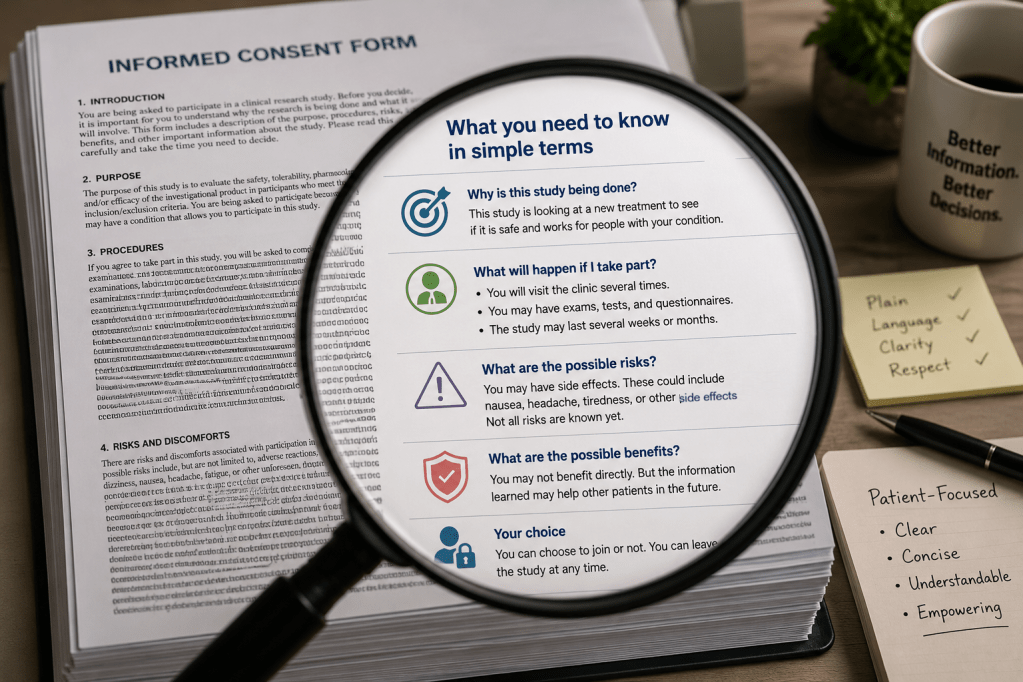
Tone and document structure also fundamentally dictate how informed consent disclosures are processed. Plain language guidelines recommend shorter sentences, active voice, logical headings, and clear formatting to maximise information retention (NIH, 2025). Structuring information using question-based headings such as “Why is this study being done?” or “What are the possible risks?” significantly improves document navigation and reduces the cognitive burden on participants reviewing extensive consent paperwork (European Commission, 2022).
Medical writers must also strictly avoid promotional or persuasive language within clinical documentation. Ethical and international regulatory guidance emphasises that consent documents must remain strictly objective, never overstating potential therapeutic benefits or minimising known safety risks (WMA, 2013). Phrasing that unintentionally induces participation or creates unrealistic clinical expectations directly compromises the ethical integrity of the voluntary consent process (WMA, 2013).
Cultural and literacy variations further complicate this communicative dynamic. Patients from diverse linguistic, cultural, and educational demographics interpret medical terminology differently, particularly when complex clinical jargon or idiomatic expressions are introduced (IOM, 2004). Medical writers must therefore evaluate structural readability, translation parity, cultural appropriateness, and audience diversity when engineering patient-facing research materials (IOM, 2004).
The increasing emphasis on patient-centric healthcare has expanded the professional scope of the medical writer. Modern informed consent is no longer handled solely as a regulatory shield, but increasingly as a functional communication tool designed to support meaningful patient understanding and autonomous decision-making (Menikoff et al., 2017). Consequently, medical writers are expected not only to communicate scientific parameters accurately but also to anticipate how participants emotionally and cognitively interact with dense medical disclosures (Yuan et al., 2023).
In practice, this operational workflow requires seamless collaboration across multidisciplinary clinical trial teams, including investigators, regulatory specialists, corporate lawyers, ethics committees, and patient advocacy groups. Medical writers must systematically negotiate these competing institutional priorities while maintaining structural clarity, scientific integrity, and absolute regulatory compliance (Montalvo & Larson, 2014; NIH, 2025).
Ultimately, the validity of an informed consent process depends heavily on how effectively critical trial information is communicated. Within this context, medical writers serve as an essential bridge, translating regulatory complexity into meaningful patient comprehension.
Emerging Solutions and Modern Approaches
Growing concerns about patient comprehension have prompted the development of new approaches to improve the effectiveness of informed consent communication in clinical research (Yuan et al., 2023). These modern modalities aim to reduce cognitive burden, maximise readability, and support more meaningful participant understanding while maintaining absolute regulatory and ethical compliance (Yuan et al., 2023).
One increasingly discussed strategy is the execution of layered or tiered consent models. Layered consent involves presenting essential study parameters in shorter, simplified summary blocks while allowing participants to access detailed, granular disclosures separately if desired (ICH, 2025). This structural pacing is formally operationalised through the “Key Information” framework under the modernised ICH E6(R3) Good Clinical Practice guidelines (ICH, 2025). This regulatory framework provides a structured, tiered blueprint specifically engineered to prevent the immediate cognitive information overload typically caused by extensive technical text at the start of the consent process; therefore, by prioritising critical decision-making concepts upfront within a concise summary block, this tiered architecture helps participants process essential trial elements quickly before reviewing legally mandated technical sections (ICH, 2025; Yuan et al., 2023)..
Summary sheets and concise introductory overviews are increasingly used to improve navigation and readability within lengthy informed consent forms (ICFs). These digital dashboards synthesise critical data, such as study purpose, primary risks, expected benefits, and participant responsibilities, using plain language and highly structured formatting (European Commission, 2022); therefore, by presenting core concepts upfront, summary-based approaches help participants identify essential trial elements quickly before reviewing legally mandated technical sections.
Visual aids and graphical communication tools also serve as a primary mechanism for improving participants’ understanding. Interactive diagrams, timelines, flowcharts, infographics, and icon-based risk matrices communicate complex study procedures, randomisation ratios, and treatment schedules more effectively than text alone (Yuan et al., 2023). Visual communication is particularly beneficial for individuals with limited literacy or numeracy skills, as it translates mathematical probabilities into accessible spatial representations (IOM, 2004; Yuan et al., 2023).
Electronic informed consent (eConsent) platforms have completely transformed traditional paper-based consent processes (Food and Drug Administration [FDA], 2024). Validated eConsent frameworks incorporate responsive multimedia features such as video tutorials, animations, interactive learning modules, voice narration, and embedded comprehension check-points designed to maximise participant engagement and retention (Yuan et al., 2023). These digital interfaces allow participants to review complex information at their own pace and instantly revisit dense sections as needed.
Video-assisted consent approaches demonstrate significant operational benefits in specialised clinical environments. Multimedia explanations improve the comprehension of invasive clinical procedures and support long-term memory retention compared with standard text-only formats (Yuan et al., 2023); however, empirical evidence regarding the effectiveness of digital consent tools remains variable; optimised visual presentation alone does not automatically guarantee a deep, autonomous understanding if the underlying message remains uncontextualised.
Patient co-creation and user feedback loops are now recognised as critical components of ethical ICF development. Clinical guidelines recommend involving patient advocacy groups or public representatives in reviewing draft consent materials to evaluate formatting, readability, and logical navigation before trial initiation (European Commission, 2022). User-experience testing identifies confusing medical terminology, poorly structured layouts, and latent communication barriers that clinical sponsors and medical writers frequently overlook (European Commission, 2022; Yuan et al., 2023).
Readability assessment software and plain language frameworks are standard utilities within modern medical communication. Writers use algorithmic readability metrics, audience testing criteria, and plain language principles to evaluate vocabulary burden and sentence complexity (NIH, 2025). Although automated readability scores cannot fully assess authentic comprehension, they serve as vital diagnostic indicators to flag sections that require simplification or restructuring (IOM, 2004; NIH, 2025).
Despite these technological advancements, structural challenges persist. Digital consent tools optimise visual delivery but fail to address underlying comprehension deficits if the medical information remains overly technical or poorly contextualised (Yuan et al., 2023). Furthermore, digital disparities mean that not all participants have equal access to hardware or feel comfortable navigating electronic interfaces, creating an equity barrier for elderly individuals and digitally excluded groups (Berkman et al., 2011; Yuan et al., 2023).
From a medical writing perspective, these emerging approaches reinforce the reality that informed consent must be designed as an ongoing communication process rather than a static legal contract. Effective consent communication relies entirely on how clinical data is structured, presented, reinforced, and continuously adapted to the participant’s human needs throughout the research lifecycle.
Current Challenges and Future Directions
Despite growing recognition of the importance of patient-centred informed consent communication, several challenges continue to affect the effectiveness, consistency, and accessibility of informed consent forms (ICFs) within modern clinical research (Yuan et al., 2023). These challenges involve not only document readability, but also broader operational issues relating to technology adoption, cross-cultural adaptation, evolving regulatory expectations, and the future role of communication within research ethics.
One major challenge is the continued lack of global standardisation in informed consent practices (WMA, 2013; ICH, 2025). Although international ethical frameworks establish broad principles for informed consent, implementation requirements differ significantly across sovereign jurisdictions, local institutions, ethics committees, and clinical trial sponsors (WMA, 2013; ICH, 2025). Variations in mandatory legal language, regional data privacy laws, and conflicting institutional boilerplate policies contribute to profound inconsistencies in consent quality and structural readability across global trial sites (ICH, 2025).
Conclusion
Informed consent is designed to protect patient autonomy and facilitate autonomous decision-making within clinical research. However, modern informed consent documents have evolved into dense, legalistic frameworks, frequently embedding exhaustive scientific, regulatory, and corporate language that severely compromises participant comprehension.
As demonstrated throughout this article, systemic readability barriers, widespread health literacy deficits, uncontextualised technical terminology, and cognitive information overload consistently undermine meaningful patient understanding, even when strict regulatory compliance is fully achieved. Consequently, genuine informed consent must transcend the passive collection of signatures and the mere distribution of exhaustive paperwork.
Within this communicative paradigm, medical writers serve a critical ethical function. Translating intricate clinical parameters and rigid regulatory mandates into accessible, balanced, and patient-centric documentation remains a foundational prerequisite for supporting ethical human subject research.
Ultimately, the ethical validity of the informed consent process relies not on the volume of information disclosed, but on whether research participants can realistically comprehend, retain, and apply that information when choosing to volunteer for clinical trials.
Reference
Appelbaum, P. S., Roth, L. H., & Lidz, C. (1987). The therapeutic misconception: Informed consent in psychiatric research. International Journal of Law and Psychiatry, 5(3–4), 319–329. doi.org
Beardsley, E., Jefford, M., & Mileshkin, L. (2007). Preparing patient information leaflets for oncology clinical trials: Is there evidence for the content, length, and readability? Journal of Clinical Oncology, 25(13), 1803–1804. doi.org
Berkman, N. D., Sheridan, S. L., Donahue, K. E., Halpern, D. J., & Crotty, K. (2011). Low health literacy and health outcomes: An updated systematic review. Annals of Internal Medicine, 155(2), 97–107. doi.org
BMJ Open. (2024). Understanding the language barriers to translating informed consent in clinical trials: A systematic evaluation. BMJ Open, 14(4), Article e076744. doi.org
European Commission. (2022). Commission notice — Guidance on the transition of clinical trials from the Clinical Trials Directive to the Clinical Trials Regulation (CTR) No 536/2014 (2022/C 275/01). European Union Public Health. europa.eu
Flory, J., & Emanuel, E. (2004). Interventions to improve research participants’ understanding in informed consent for research: A systematic review. JAMA, 292(13), 1593–1601. doi.org
Food and Drug Administration. (2024). Decentralized clinical trials for drugs, biological products, and devices: Guidance for industry, investigators, and reviewers. U.S. Department of Health and Human Services. fda.gov
Grady, C. (2015). Enduring and emerging challenges of informed consent. New England Journal of Medicine, 372(9), 855–862. doi.org
Institute of Medicine. (2004). Health literacy: A prescription to end confusion. The National Academies Press. doi.org
International Council for Harmonisation. (2025). Guideline for good clinical practice E6(R3). Final version. https://database.ich.org/sites/default/files/ICH_E6%28R3%29_Step4_FinalGuideline_2025_0106.pdf
MDPI. (2025). Readability of informed consent forms for medical and surgical clinical procedures: A systematic review. Publications, 15(2), 26. doi.org
Meeker, C. R., Groman, M. E., & Wendler, D. (2021). A modern history of informed consent and the role of key information. Journal of Clinical Oncology, 39(10), 1056–1062. doi.org
Menikoff, J., Kaneshiro, J., & Pritchard, I. (2017). The common rule, updated. New England Journal of Medicine, 376(7), 613–615. doi.org
Montalvo, W., & Larson, E. (2014). Participant comprehension of research for which they volunteer: A systematic review. Journal of Nursing Scholarship, 46(6), 423–431. doi.org
National Commission for the Protection of Human Subjects of Biomedical and Behavioral Research. (1979). The Belmont report: Ethical principles and guidelines for the protection of human subjects of research. U.S. Department of Health, Education, and Welfare. hhs.gov
Nishimura, A., Carey, J., Erwin, P. J., Tilburt, J. C., Murad, M. H., & McCormick, J. B. (2013). Improving understanding in the research informed consent process: A systematic review of 54 interventions tested in randomized control trials. BMC Medical Ethics, 14, Article 28. doi.org
Paasche-Orlow, M. K., Taylor, H. A., & Brancati, F. L. (2003). Readability standards for informed-consent forms as compared with actual readability. New England Journal of Medicine, 348(8), 721–726. doi.org
The Lancet. (2024). The literacy barrier in clinical trial consents: A retrospective analysis. EClinicalMedicine, 76, Article 102837. doi.org
World Medical Association. (2013). World Medical Association Declaration of Helsinki: Ethical principles for medical research involving human subjects. JAMA, 310(20), 2191–2194. doi.org
Yuan, S., Chen, I., Tsai, L., & Lin, L. (2023). Participants’ understanding of informed consent in clinical trials: A systematic review and meta-analysis. Trials, 24, Article 812. doi.org


Leave a Reply